Intangible capital: what makes your company singular, and how to keep it in-house
What does your company really own, that appears nowhere, and how do you keep it? What it owns that is singular is neither its machines nor its software, which a competitor can buy tomorrow. It is what it knows: its customers, its craft, its processes, its market, and everything that explains why it does what it does, how it does it, and where it is going. That is its intangible capital, a capital made of knowledge, and it appears on no balance sheet. It has always worked without being written down. Artificial intelligence (AI) is now writing it down, one use at a time, whether you want it or not. The only question that matters is where: in-house, where it becomes the most powerful asset you have, or inside other people's tools, where it crumbles.
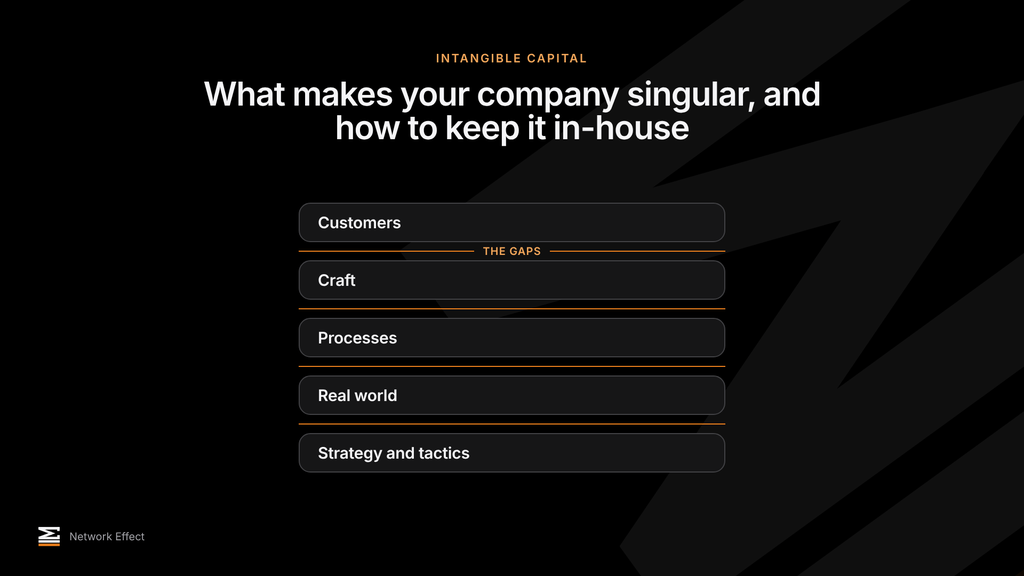
What makes a company singular is, to a large extent, its intangible capital.
What makes my company singular?
Take two companies in the same trade, the same size, on the same market, with the same machines and the same software. They are not alike: one wins the customers the other loses, one knows where it is going. The difference is on neither balance sheet. It lies in what each of them knows, and that knowledge comes in layers.
Knowledge of customers. Not the customer file, the knowledge: who buys, why, what each of them does not say, what once made them leave and come back, the history of every relationship. A customer file can be copied; knowledge of one's customers cannot.
Knowledge of the craft. What a job well done looks like, and how you recognise it. The rules of thumb nobody ever writes down because they go without saying for those who have them. What you refuse to do, and why.
Knowledge of processes. Not the written procedure, but the way things actually get done: who to call when something is stuck, what gets checked twice, what can be let through.
Interactions with the real world. Suppliers and what they are worth, the field, what the market says before the numbers say it, the weak signals the owner picks up before anyone else because they have met the people.
Strategy and tactics. Why this customer base and not another, what was given up, the bets made and the bets lost, and where the company is going.
And beneath those layers, what connects them: the gaps. Everything that is written down or digitised nowhere. What is informal, what lives between the tools, in hallway conversations, and above all in the founder's head. The reasons behind decisions, even more than the decisions. What the company knows without ever having said it. That is where most of what explains why the company does what it does, how, and where it is going, is to be found.
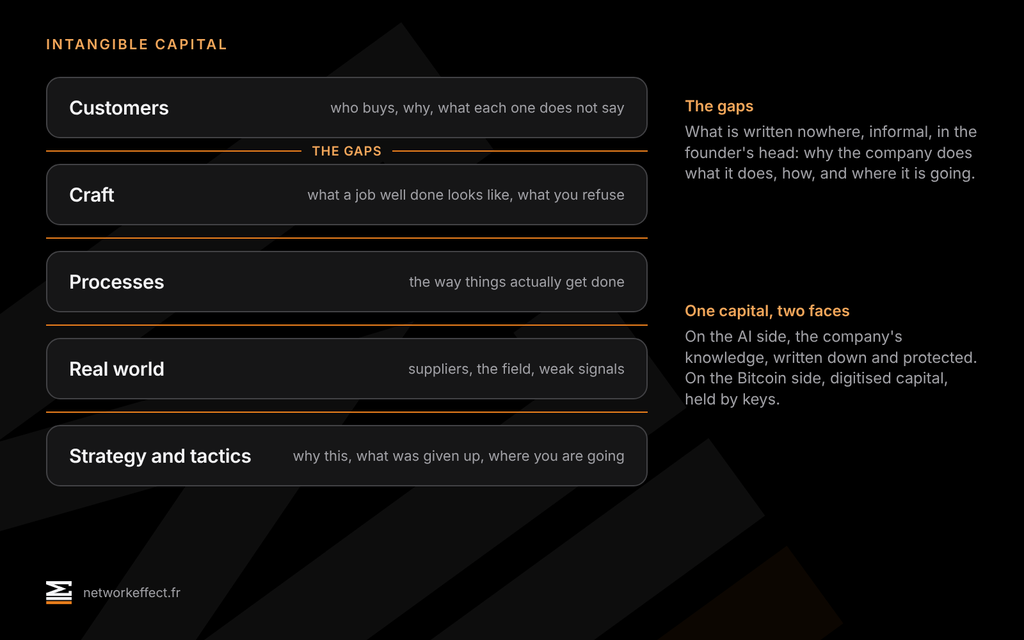
All of this is capital: it accumulates, it is passed on, it produces. It is not tangible, and accounting, which records what a company bought rather than what it built, does not see it. But it has a property nothing else has: it is singular. Nobody else has it, and nobody can buy it. It has always worked without being written down, from one head to the next, by example, over the years. AI changes that.
Why is AI digitising this capital, whether I want it or not?
A generic AI gives generic answers. To serve your company, it has to read its real context: what it sells, to whom, how, under what constraints, and why. That context exists nowhere in readable form until someone writes it down. So it gets written down. Every use of AI pulls a little knowledge out of people's heads and puts it into text: an instruction that spells out how you work, a document handed over to be read, an automation set to your rules, an answer corrected because it did not sound like you. Every correction is a piece of a gap that has just been digitised.
Digitising intangible capital is therefore not a project anyone decides on. It is under way, one use at a time, in every company that has put AI to work.
And it is an opportunity. Written down and structured, this capital changes nature. It stops evaporating when people leave; the company's memory, which stopped being built when everyone queried an AI on their own, is built again, in one place. It becomes usable: an AI that reads it answers your questions, not generic ones. It becomes queryable: you can ask it what the company has already decided on a subject, and why. It becomes reusable, by your agents today and by those of tomorrow; an AI agent is a program that acts on its own, it reads, prepares, executes. And the most important part plays out over time: aggregated and digested by ever more powerful models, this capital yields, on long-term strategy, results that three heads, however good, could never produce. Models come and go; your corpus stays.
Everything then depends on one thing: where this digitisation happens. Because that place decides who holds the capital.
What do you lose when agents are scattered across platforms?
The temptation is everywhere, and it looks reasonable. Every tool the company uses now offers its own agent: the assistant in the mail client, the one in the sales software, the one in the document platform, the one in customer support. You plug it in, explain how you work, correct its first answers, and it automates. You gain speed of implementation: within a week, four agents are running, each inside its own tool.
And you lose the knowledge. What each agent has learned from you, your rules, your corrections, the reasons you gave it, has gone into the tool in a form that is not yours. You cannot export it: there is no file. You cannot bring it back in-house, structure it, query it, or connect it to what the three other agents have learned. You cannot reuse it, not with another agent, not with your own later on, when you want a model running on your own systems. The day the tool changes its price, its owner or its terms, what you taught it stays with it.
That is what crumbling means. Intangible capital does not vanish all at once: it scatters, into as many pieces as there are tools, each piece locked in a box you cannot open. And a third party exploits it: the platform learns from you, from your customers, from the way you work, and does what it likes with it, behind your back, for itself and sometimes for your competitors, who use the same tool.
What speed cost you is autonomy. It is the trade described by the corpus trilemma: fast, because a trusted third party holds everything and unlocks it for you; and therefore not autonomous. The question to ask of every agent is no longer “what can it do?” but “where does what it learns about us go, and can we take it back?”.
Crumbling or holding. Bitcoin posed exactly that choice, fifteen years ago, for the other face of intangible capital.
What did Bitcoin understand before everyone else?
On the Bitcoin side, intangible capital is digitised capital: value itself turned digital, not a representation of it. A bank balance is a promise from the bank, a line in its ledger. A bitcoin is the thing itself, a unit of a currency with a fixed supply, held by keys, that is, by a secret its holder keeps on a device or on paper, and transferable without asking anyone's permission. The law may give it a name and the accountant a line on the balance sheet; neither says who holds the keys.
Fifteen years of holding have taught the world a rule that fits in one sentence: not your keys, not your bitcoin. Digital capital entrusted to a third party is no longer yours: it is yours as long as the third party is willing, as long as it exists, as long as it is not attacked. Bitcoin holders learned this the hard way, and drew a discipline from it: keep your own keys, spread them across several people when you are a company, and test recovery before you need it.
Now look at the two faces side by side: they are of the same nature. Neither is “somewhere”: both are wherever the keys are, that is, wherever the power to read, move and keep sits. Both are held or lost, with no recourse: knowledge gone with a person, knowledge locked inside a closed tool, a lost key, nobody gives them back. Both can be stolen without anyone noticing, because copying does not take anything away; that is why we say it is better to rebuild your data than to have it stolen. And both are protected by the same thing, public-key cryptography: what secures a bitcoin can seal your company's brain.
One capital, two faces, one rule of custody. That is why we do not treat Bitcoin and AI as two subjects side by side: they put the same question to the business owner, who holds the keys to what the company really owns.
Intangible capital
One capital, two faces.
What your company knows
Its strategy, its decisions, its weak signals, its exchanges with the real world. Recorded with care, it is what an AI has to read to serve you, and what you have to protect.
What it holds
With Bitcoin, value itself becomes digital: digitised capital, held by keys, transferable without an intermediary.
Under your keys
Two faces of one capital: what makes your company singular. Scattered across third parties, it frays; held at home, it lives and improves. Both are protected the same way: by your keys.
How do I keep my intangible capital in-house, and keep it alive?
Keeping it comes down to three moves, and they are the same on both sides.
Write it down. Write what has never been written, starting with the gaps: interviews with the owner and the key people, the founding decisions and their reasons, the weak signals, what the founder knows without having said it, the rules of thumb of the craft, the way things actually get done. Not in a piece of software: in files the company owns, readable by a human and by any AI model, today or in ten years. That is the corpus. On the Bitcoin side, writing it down means naming what you hold, where, and under which keys, in a document the right people know about.
Hold it. The corpus in-house. Agents come to read it, rather than your knowledge leaving to live inside agents: that reversal of direction changes everything. Then the trust architecture, unique to each company: what stays readable so the AI can work fast, and what is encrypted with your keys; where the model runs, in-house or with a provider, and on what contractual terms; and, because a company is not a person, several key holders rather than one, like the multi-signature (multisig) setup Bitcoin perfected, with recovery tested before the day you need it. None of this is a tool to buy: it is a drawing, made once and written down.
Keep it alive. A corpus that is not updated becomes a snapshot. You connect it to the company's flows, its documents, its exchanges, its new decisions; you query it, correct it, improve it, and every correction enriches it instead of enriching a third party. This is where long-term strategy is decided: the same corpus will serve every generation of models, each more powerful than the last, and what each one draws from it will depend on what you put in, not on the model. On the Bitcoin side, keeping it alive means written rules for the treasury and recovery drills.
We recommend no tool and no provider, and we give no investment advice: we design the architecture with you, and we help you write what has never been written.
What your company really owns
What your company really owns is its singularity, and it is made of knowledge: its customers, its craft, its processes, its market, and everything that lives in the gaps and explains why it does what it does. AI is writing it down. Either that capital crumbles inside other people's tools, piece by piece, and someone else profits from it. Or it stays in-house, written down, held, alive, and becomes the most powerful asset you have, digested by ever stronger AI. The challenge is no longer to adopt AI, but to know what to do with it, and why.
Where to start: CORPUS, to write down and hold what your company knows; VIRAGE, so that AI serves your long-term strategy instead of replacing it; Payments and treasury and the F102 course, for the other face of the capital, the one held by keys; and a conversation, half an hour, to decide which comes first.
Let's talk about your project.
A question, a training course, a payment or AI project? Write to us. We answer ourselves, and quickly.