Delegating to the algorithm means choosing your masters: who sets the goals your AI optimises?
"Let's leave it to the tool, it has more data than we do." You have heard that sentence, and perhaps said it. It is not absurd: the tool often does have more data than you, and on some things it makes fewer mistakes. But an algorithm does not optimise "the good", nor "your interest". It optimises a function, a numerical objective, written by engineers, under constraints set by whoever funds them, to serve whoever controls it. Handing a decision to an artificial intelligence (AI) does not remove the decision-maker. It replaces them, out of sight. So the question is not whether you keep control, but who sets the goals your AI pursues. It makes less noise than the fear of "losing control", and for a company it is more serious.
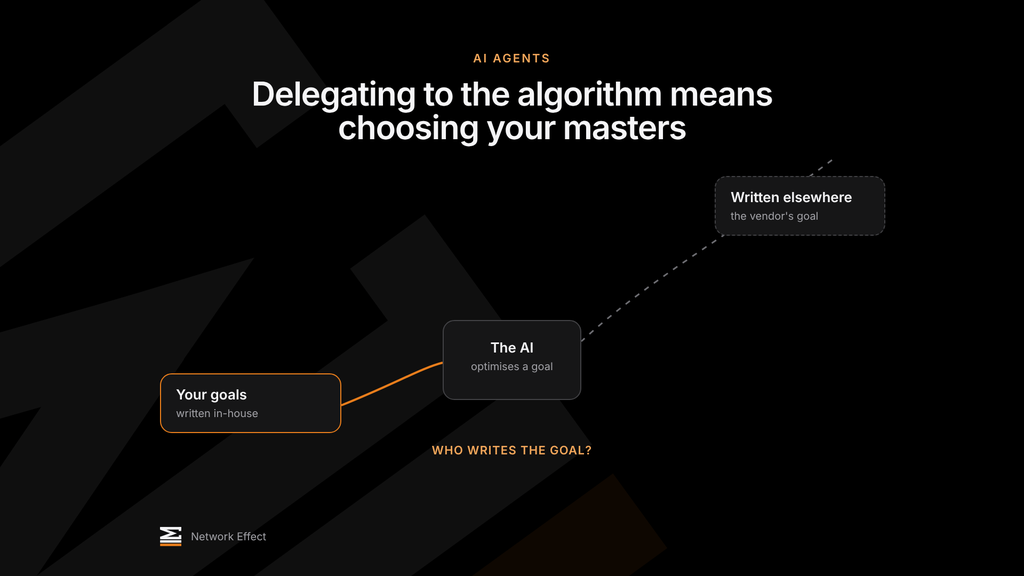
Delegating to the algorithm means choosing your masters. Not escaping control.
AI decides better than I do: why not let it?
The argument looks sound. Humans make mistakes, from fatigue, bias or self-interest; a more powerful intelligence will make fewer; so let it decide. It even has a strong version worth acknowledging: human organisations chase the short term, and a system that holds a line for years, without tiring, without bending to the mood of the quarter, would have something to teach them. And AI already decides, often better than we do, in a thousand settings: logistics, forecasting, spotting anomalies. The debate is not "AI or no AI".
But the argument hides a confusion. It swaps the question "how should AI be governed?" for "should AI be governed at all?", and answers no, without looking at who benefits from the abstention. Intelligence and alignment are two different things. A system can process information better than any human and still pursue a badly defined goal, which it will then pursue with remarkable efficiency. The quality of an automated decision depends entirely on the quality of the goal it was given, and defining that goal is a human matter. An AI can optimise a function; it cannot settle a conflict between two values, margin against a customer's loyalty, growth against independence, unless someone has first told it which one comes first.
That AI will take up more room is likely. That says nothing about who defines what it pursues, for whom, and with what mandate.
Who wrote the goal my tool is optimising?
Two losses need telling apart. Losing control means watching AI act without you. Losing sovereignty means letting third parties define what it works towards. The second one makes no noise at all.
When a company adopts an AI tool without having defined its own goals, it adopts the vendor's by default. And a vendor has legitimate goals that are not yours: its number of users, how long they stay, how much they use its other products. The assistant in your sales software optimises what its vendor measures. Its intelligence may be excellent; the goal it pursues may be foreign to your interests. Letting it frame your priorities does not make you more intelligent. It outsources the definition of your goals to an infrastructure whose values, incentives and future you do not control.
The trap has an internal version. Replacing layers of management with coordination systems does not remove the question of power; it moves it. Who controls the system? If it is a third party, the human hierarchy has been replaced by a dependency, all the quieter for presenting itself as "objective" and "data-driven". In 1945 the economist Friedrich Hayek pointed out that the useful knowledge in an economy is dispersed, and that no planner ever sees more than a sliver of it. A goal written far from your ground knows nothing of what only your company knows.
This is where the question meets intangible capital. Your goals, the reasons behind your decisions, what you chose to give up: they belong to what the company knows without having written it down, the gaps. A goal you have not written, someone else has written for you. It is the part of intangible capital an AI must read before any other, and the first to keep in-house; our article on intangible capital describes the other layers.
This loss is not a power grab. It is consented to, and that is what makes it last.
Why is it so comfortable to let it happen?
In 1840, in the second volume of Democracy in America, Alexis de Tocqueville described a new kind of power that forbids almost nothing. In Henry Reeve's translation, it "covers the surface of society with a network of small complicated rules, minute and uniform"; the will of man "is not shattered, but softened, bent, and guided"; and every day it "renders the exercise of the free agency of man less useful and less frequent". Set aside Tocqueville's subject, which was political. Keep the mechanism, because it applies to a company: a dependency that spares someone the need to exercise a capacity creates the conditions for losing it.
A capacity you do not use withers. Muscles, a foreign language, a craft skill, and judgement. Delegating to AI, when nobody governs the delegation, reproduces that mechanism, not by force but by disuse. The business owner who delegates without keeping up the practice of reasoning does not lose the freedom to decide. They make it useless. Not every dependency does this: you rely on your accountant without losing your mind. The risk lies in ungoverned dependency, the kind nobody has set limits to.
In the sixteenth century, La Boétie named voluntary servitude. Its modern version has a simple economic mechanism: you rationally choose to delegate as long as the perceived cost of deciding for yourself outweighs the perceived benefit of freedom of action. That is a stable equilibrium. It only breaks if the cost of leaving falls, or if the system stops keeping its promise. Which leaves an uncomfortable question: how fast does a capacity to decide grow back once it has withered? If the answer is "never quite", delegation is not a reversible state.
AI tools add a feature that makes leaving expensive: their concentration.
Am I someone's tenant without knowing it?
The large AI models are in the hands of a handful of players, nearly all of them American. For a company, that is a strategic dependency comparable to an energy dependency: you can run perfectly well without ever controlling the conditions you run under. People sometimes speak of digital lords: the lord no longer owns the land; he owns the access.
The relationship has four asymmetries. Of access: whoever designs the tool has the full version, the user the filtered one. Of information: observation runs one way; the tool knows you, you do not know it. Of power: your productivity, sometimes your income, depends on it, not the reverse. Of exit: the more indispensable the tool becomes, the more leaving costs. The castle and the corvée were visible; terms of service and an algorithm are not. The cage is gilded: plenty of comfort, a little less capacity to decide every year.
What a company rents, and what it can truly own around AI, has an article of its own: Renting your AI.
A caveat: dependency is not always avoidable; refusing the dominant supplier of a key component can cost years. Whether to rent your AI or own it is a question that deserves an examination of its own. But the conclusion lies elsewhere: a company's sovereignty is decided neither by its choice of hardware nor by its choice of model. It is decided by the goals it formulates, and by what it would cost it to leave.
Is there an architecture where the rules are public and nobody holds the controls? There is one, and it has been running for more than fifteen years.
What does a system without masters look like?
Bitcoin is a system of rules without rulers, in the phrase of Andreas Antonopoulos, one of its best-known explainers. A fixed supply of 21 million units, a block roughly every ten minutes, and public rules that every node, a computer that checks the chain, applies for itself, and that no operator and no company can change alone. This is not an absence of rules. It is an architecture designed to resist capture by any single operator. The real divide is not between those who want rules and those who do not; it is between an architecture of control, where a third party holds the gate, and an architecture of exit, where anyone can leave without asking permission. Digitised capital, under your own keys, asks nobody's permission: it has no master.
Bitcoin also teaches something about the cost of leaving. Mediocre systems last not because their participants believe in them, but because leaving costs too much; when sovereignty becomes cheaper than dependency, the switch happens, not through revolution but through quiet migration. And an intermediary, however well-meaning today, remains a single point of failure: it can change owners, terms, preferences. Swapping one supplier for a friendlier one does not end the problem. It transfers it.
Applied to a company: you do not escape a dependency through heroics; you make it revocable by lowering the cost of leaving. Goals written in-house, readable by your teams and by any model; your data in files you own; a model you can swap without rewriting everything. And the mere possibility of leaving, even if never used, keeps the supplier honest.
Formulating your goals is a skill, and it can be practised.
Where does a company that wants to stay master of its goals begin?
When everyone has the same tool, what remains different is intent: knowing precisely what you want to do with AI, and what you want to protect yourself from. Every technology amplifies an intent; without one, it amplifies confusion. Staying master of your goals is not a moral virtue. It is a stance: "we decide how AI enters our project", not "let's see what we're offered".
It starts with a question, before any purchase: what do we want to achieve that we cannot do today? If there is no answer, AI is not the answer. Then comes a kind of company constitution, short and written: which decisions AI may take; which stay under the company's own governance; which trade-offs you refuse to leave to it; and which places you deliberately keep alive so that collective judgement is exercised independently of what AI produces: a team deliberation, a committee that pushes back, an internal counterweight. Those are what prevent the withering.
A fair objection: clarity is not enough, and many business owners discover their strategy as they go, not beforehand. That is why this is a practice rather than a fixed plan: goals written, reread, revised, held up against what AI produces. Many leaders have an accurate diagnosis of their situation, and structural decisions they keep putting off; the useful moment is the one where the diagnosis becomes a commitment. Deciding what you ask AI to optimise is, in any case, only half of control; the other half is checking what it produces, and that is the subject of another article.
AI will not decide in your place. Someone will decide through it, and if it is not you, it is whoever wrote its function. Formulating your goals yourself, writing them down in-house, and keeping up the practice of deciding: that is the only sovereignty money cannot buy.
It is the third of the convergences between Bitcoin and AI, sovereignty: your data structured and your own, your AI where you decide, your money under your keys. And it is where VIRAGE (French for "the turn"), our half-day workshop, begins: starting from your long-term goals, and working out where AI comes in, in what order, and with what context.
Let's talk about your project.
A question, a training course, a payment or AI project? Write to us. We answer ourselves, and quickly.