Zero times a thousand: what AI amplifies, and what it will never give you
Two companies in the same trade adopt the same artificial intelligence (AI) tools, the same models, the same subscriptions, at the same time. A few months later, their results have nothing in common: one is producing well-presented noise, the other is doing things it could not do before. The variable is not the tool, since it is the same one. It lies in what each company gave it to multiply. Many still believe AI makes substance out of nothing: with the right instruction and the right tool, ideas, strategy and value would simply appear. That is the fundamental misunderstanding. AI generates, and very well, but from what it is given; feed it emptiness and it hands back emptiness, better packaged. Three things cannot come from it: the will to start, the taste to choose, and a conviction.
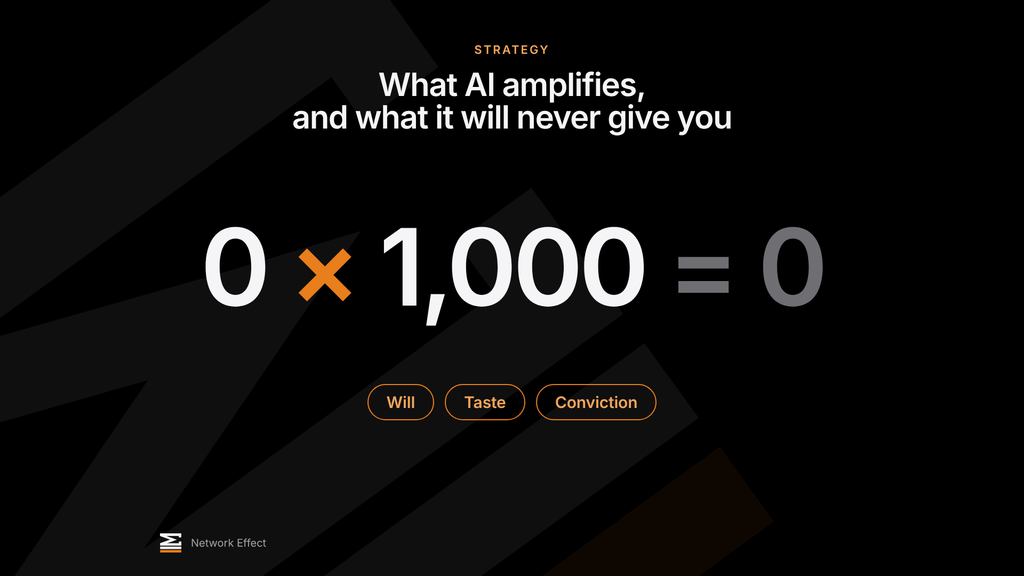
AI is a lever. Multiply zero by a thousand and you still have zero.
Why do two companies with the same tools get such different results?
Because the advantage has left the tool. Every technology cycle follows the same path. At first, the advantage lies in access: those who have the technology beat those who do not. Then it lies in mastery: those who know how to use it beat those who merely bought it. Finally, once everyone has access and roughly knows how to use it, the advantage leaves the technical layer and moves up to the layer of judgement.
AI is following that path, fast. Access to the best models will soon be a baseline, like having internet access, rather than an edge. In 1995, in an interview broadcast the following year, Steve Jobs said Microsoft's only problem was that it had “absolutely no taste”, and added that he did not mean it in a small way. It was taken as an aesthete's jab. It was a diagnosis of competitiveness: among players roughly level on technology, what decides is neither the patent nor the budget but the discernment of the people making the calls. That cycle used to take twenty years. With AI, it will take a few.
If the advantage moves up to the person holding the tool, we need to look at what that person brings to it.
Does AI create something out of nothing?
No. Any system that amplifies returns an output in proportion to its input. The real work is never the AI itself: it is building, beforehand, what it will act on. The secret is not the instruction you give it; it is having spent years reading, thinking, building, arguing and correcting yourself.
There is a threshold. Below it, AI changes almost nothing: it produces generic work, faster. Above it, it changes everything. The bottleneck moves from “I have the idea, I need three hours to write it up” to “I have the idea, I need two minutes to test it”. That is not a gain of a few per cent; it is a change of category, reserved for those who have something to multiply.
The threshold is not a wall. AI is not all or nothing: it also helps you climb, step by step, as long as you know where you are climbing to. The “something” to multiply comes down to three things, which are not skills but positions.
What AI cannot supply: the will to start?
The first is the urge to act: deciding that something is worth undertaking. AI automates execution once the request is clear; it does not decide which task deserves to exist. In a system where AI does the work, the human belongs at both ends: intent at the start, validation at the finish. Not in the middle, doing the execution. It is the structure of the composer and the orchestra, of the architect and the building site. It has existed for a long time; AI simply makes it available to everyone.
This is where AI reveals the leader rather than measuring them. Asked in March 2026 about companies cutting staff in the name of AI, Nvidia's chief executive Jensen Huang told CNBC that when leadership is out of ideas, more capability does not lead them to do more. It is a useful provocation, not a verdict. The objection is fair: imagination alone is not enough; the structures have to allow it. Governance, shareholders' time horizon, the state of an industry, whether you control your own infrastructure: these weigh as much as the will, and cutting staff is sometimes a real constraint rather than a failure of imagination.
For a leader who hesitates, the order of the questions matters. First: do I want to? Not permission: the urge. Only then: do my structures let me?
Will gets things started. It does not tell you whether they are any good.
What AI cannot supply: taste?
AI generates a million variations; it does not know which one should live. Taste is knowing, faced with ten proposals, which one is right for this customer, this market, this moment. It is spotting a bad proposal before the customer rejects it, rewording a request before it produces something off-topic, seeing the real problem under the stated one. It is not a gift. It is embodied memory, made of years of interactions, mistakes, customers lost and won back, condensed into instant intuition. The economist Frank Knight distinguished in 1921 between risk, which statistics can measure, and uncertainty, which nothing in the past can settle: taste works in the second.
There are two kinds of taste. Corpus taste reproduces the dominant codes of a field: AI imitates it very well, having read those codes. Field taste is anchored in relationships, places and situations the AI has not lived through: it recognises what is right for this particular customer, not for the average. Only the second is an advantage.
Will and taste complement each other; neither replaces the other. Taste without will starts nothing: you know how to choose, but you never launch. Will without taste produces noise: you launch everything, and none of it is good.
Hence a question to ask inside the company: who on your team has taste? Not in the artistic sense, in the operational one. Who spots the quote that will put the customer off, the answer that rings false, the project that will not hold? Do you know? These people are among the most valuable assets of the AI era. Are they identified, protected, listened to?
Will and taste are positions. What remains is what feeds them, and that is built over time.
What AI cannot supply: a conviction?
The third thing is what the leader has to say that nobody else can. A conviction is not an opinion. It is forged from facts, systems, years of tested experience, a dense web of connected ideas; and originality is connecting what nobody had connected before. It cannot be bought, and no tool truly speeds up its construction.
Bitcoin holders know something about this. A conviction is built like a long position, with low time preference: preferring what will be worth something in ten years to what pays off tomorrow. Bitcoin, with its fixed supply and declining issuance, is designed to reward that patience. And fifteen years of turbulence have taught its holders that the only conviction that holds is one you built yourself, by understanding the mechanism, without relying on a promised outcome. Bitcoin promises nothing; it imposes a process that anyone can verify. A leader's conviction is forged the same way: through process, not promise.
Two nuances, to stay honest. Holding a position over time is not only a matter of conviction; it is also a matter of cost, the cost of getting out. And experience can become a liability when it hardens into risk aversion and attachment to past decisions. Adopting Bitcoin required many people to unlearn what they thought they knew about money. A living conviction knows how to unlearn; a frozen certainty does not.
Once the conviction is clear, AI does not replace it: it frees it. It becomes the infrastructure that puts it to work, at scale.
Where do I start on Monday morning?
AI does not augment your company: it reveals what it really is. If it amplifies, it also shows what is missing, which is good news, provided you look. So the first battle is not technological, it is about thinking: before deploying the machine's capabilities, test the leader's.
Three questions, one for each thing:
- Do you want to start? Not permission: the urge.
- Who has taste in your company? And do you know?
- What do you have to say that nobody else can?
Strategic clarity is what those three answers draw: choosing, giving things up, making trade-offs. Whatever is precise in the answer, the context, past decisions, their reasons, gets written down. What AI multiplies is what the company knows and what its leader has decided, the reasons, the things given up, the weak signals: its intangible capital, carefully written down. A conviction that stays in one head is multiplied by one; written down, it is multiplied by a thousand. And its other face, digitised capital, does not get diluted: it is made for those who think long-term.
The big AI players have an interest in keeping fear alive, because fear rushes adoption. Useful work goes the other way: turning diffuse anxiety into a structured reading, and the structured reading into a decision.
What AI reveals about you
AI is a conditional multiplier. It makes those who have already built a will, a taste and a conviction far stronger, and leaves exposed those who were counting on the tool to supply them. The good news is that all three can be cultivated.
But nobody can challenge their own thinking from the inside. FOCUS is a day in which a conviction meets people who have no interest in validating it; VIRAGE (French for “the turn”) puts AI at the service of your long-term goals rather than the other way round. For what this multiplier does to the market for expertise, read the floor rises, so does the ceiling; for what stays scarce when everything becomes abundant, the Bitcoin × AI thesis.
Let's talk about your project.
A question, a training course, a payment or AI project? Write to us. We answer ourselves, and quickly.