The floor rises, so does the ceiling: the middle disappears
An analysis, a summary, a scoping note, a first draft of a contract: work you used to pay a provider three weeks for now takes three days, sometimes three hours, at the same quality. The conclusion is not that knowledge work is worthless, nor that everyone will be replaced. It is something more precise, and more uncomfortable: the market for expertise is not moving upmarket, it is polarising. The floor, what anyone can get out of artificial intelligence (AI), has risen at once for everybody. The ceiling, what AI alone cannot produce, is rising too, but not for everybody. In between, the middle is emptying out. And that middle is both part of what your company sells and part of what it buys.
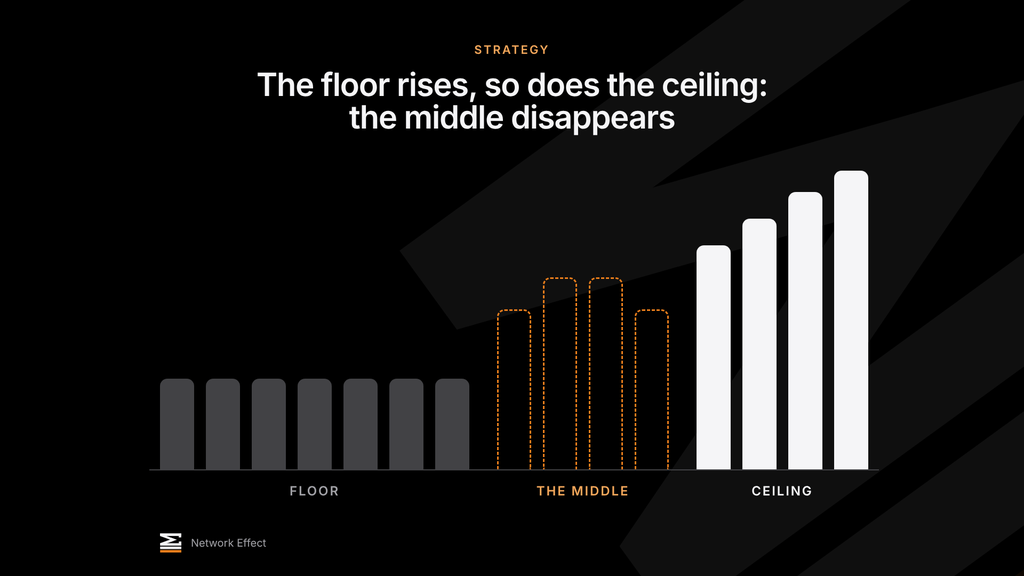
Everything that can be copied will cost nothing. Everything that cannot will cost a lot.
Why is my provider still billing me for three weeks?
Because the price was set in a world where the first draft was expensive. That world is over. AI has levelled the bottom of knowledge work: routine analysis, structured documentation, data synthesis, the first draft of a memo, the first version of a contract. These tasks now reach a high floor, the same for everyone, including the client who decides to do them in-house with a subscription.
The consequence is easy to state and heavy to carry: there is no longer any edge in being “a good analyst”. A floor that rises for everyone creates no difference; it erases the one that used to separate the competent from the beginner.
Paul Griggs, who runs PwC in the United States, put it in a March 2026 post to his firm: “AI raises the floor. Humans raise the ceiling.” It was read as a management slogan. It is really the description of a market splitting in two. If everyone rose at the same pace, nobody's relative position would change. It only changes if some rise faster than others. Which is exactly what is happening.
Why are prices falling at the bottom and rising at the top?
Two forces pull in opposite directions, and they reinforce each other.
At the bottom, abundance. When a beginner working with AI produces what a senior used to produce on autopilot, the supply of standard work explodes. That work becomes interchangeable, and prices and margins follow. This is structural deflation of standard work: a lasting fall in its price, not because demand collapses, but because producing it now costs far less.
At the top, relative scarcity. Work that requires real judgement does not disappear: telling things apart, adapting, checking, saying “this generic idea does not work here, and here is why”. It becomes more valuable, and abundance is precisely what makes it indispensable.
Before AI, a shared constraint kept the gaps narrow: time. A senior produced more than a beginner, but both ran into the number of hours in a day. AI lifts that constraint, unevenly: whoever knows what to ask for, what to keep and what to throw away gets far more out of it than whoever does not. The gap, once compressed, opens up. And top experts rarely bill by the hour; they bill for value. Producing the idea in two hours instead of two days does not lower their price. It changes their model.
Between these two forces, someone is being pulled apart.
Who goes first?
The middle. To be clear, this is not middle management inside a company; it is a position in the market for expertise. The consultant, the firm, the engineering office, the agency: competent, but not exceptional. They are caught between demand moving down (“the floor covers most of my needs, and it costs the price of a subscription”) and recognition moving up.
Photography went through this. Cheap, capable cameras wiped out the competent amateur photographer: whatever he could do, everyone now could. They also grew the market for high-end wedding photographers, whose craft, staging, directing people, the relationship, stayed out of reach of any camera, however good. The bottom was democratised, the top was revalued, the middle melted.
The strongest objection deserves a straight answer, because it concerns you. The middle is not an abstraction: it is most of the headcount in professional firms and in many departments, and it is the path along which future top experts were trained. If the floor covers most needs, the model of many juniors per senior breaks, and with it learning from the bottom up. PwC's 2026 AI Jobs Barometer, published in June 2026 and covering more than a billion job ads in 27 countries and territories, measures it: since 2019, entry-level openings that require senior skills (judgement, responsibility, adaptability) have grown by 35%, while other entry-level roles have shrunk by 10%. As PwC's Pete Brown puts it, “AI is removing some of the routine work that once acted as an apprenticeship.”
Being in the middle is not a fault. It is a position, and the market is moving it. Your company sells something; it also buys advice, expertise, services. Either way, the question becomes: what does not get cheaper?
What does not get cheaper?
Not “intelligence” in general. What holds its value is what cannot be reproduced away from where it comes from: verification anchored in the real world, context specific to a region and an industry, translation between a generic idea and the particular reality of one company, one team, one market. AI does not do this alone. Not because it is stupid, but because it has no privileged access to that reality.
The fault line runs between two kinds of knowledge. Codified knowledge can be written down, stored, passed on in text: that is where AI excels, because it is itself a distillation of written material. Tacit knowledge is hard to write down at all; the philosopher Michael Polanyi summed it up in 1966: “we can know more than we can tell.” It is the tiler setting out a room whose walls are not square, the electrician facing a fault he has never seen, the salesperson who knows why that customer left. AI dissolves the rent on rare codified knowledge. It does not touch tacit knowledge.
It dissolves another rent too: institutional prestige. For decades, clients bought the brand of a big firm as a proxy for judgement they could not see. When a client compares two invoices, three days on one side, three weeks on the other, for work of the same quality, the brand protects no one. One nuance holds: professions where the law requires an accountable signatory, insured and registered with a professional body, keep part of their rent. Not because they reason better, but because the legal system needs an identifiable human point of responsibility.
This is the line drawn by our thesis: AI makes everything abundant, except a few things that resist, real context, trust, money that cannot be printed, clear judgement. That line is not permanent: if the judgement of a trade can be encoded into specialised models, part of the ceiling will come down in turn. But it will move field by field.
When prices fall, who keeps the gain?
The word deflation is frightening, because people associate it with crises. There are two kinds. Bad deflation comes from credit unwinding: prices fall because money is scarce, companies fail, demand collapses. Good deflation comes from progress: prices fall because we produce more with less. It is the dividend of skill and accumulated capital. AI is arguably the largest fall in the cost of knowledge work in history.
The question is where that fall ends up. In a currency that can be created at will, it is largely hidden: posted prices fall little, or not at all, and the productivity gain is diluted instead of reaching those who saved. In a currency with a fixed supply, like bitcoin, falling prices stay visible, and the benefit goes to those who hold it. This is a mechanism, not a recommendation: we do not give investment advice. But it explains the site's thesis, “AI makes everything abundant; Bitcoin stays scarce”: one lowers the cost of whatever can be copied, the other decides who benefits from the fall.
Two lessons follow for a business leader. First, falling prices do not kill demand. The economist William Stanley Jevons observed it for coal in 1865: making a resource cheaper multiplies its uses. Semiconductors, whose cost has fallen relentlessly since Gordon Moore described the curve in 1965, saw at the same time the most spectacular growth in demand of the modern economy. Second, a producer cannot wait for prices to fall. The competitor who gears up now crushes him. Waiting is not a strategy.
Where should I play, and in what order?
This repricing will not accelerate forever. But we are in the transition, now and for a few years, when abundance is still speeding up, judgement is still scarce, and the gap between them is at its widest. This is the window in which an advantage is built. The printing press and photography are reminders that such transitions often go through years of chaotic pricing before new balances settle. Those who move early write down their context, the context AI does not have, and turn it into a lasting lead; those who wait for things to settle inherit a general fall in prices with nothing to protect them.
A company's ceiling is not an isolated talent: it is its real context, what it knows about its customers, its market, its constraints, carefully written down so that AI can read it and nobody else has it. That is its intangible capital; and the other face of that capital, digitised capital, is precisely what holds its value when the price of work falls.
Two questions follow, for a professional firm as much as for a manufacturing or services SME. For what you sell: in which areas is your ceiling rising faster than your floor, and where, conversely, are you only selling what your client can now get alone? For what you buy: is this provider selling you floor at ceiling prices, or judgement you will not find elsewhere? The decision is no longer to get better at everything. The illusion of being “good at everything” is gone: you have to choose where you play.
Where do you stand?
The market for expertise no longer rewards absolute quality, but scarcity. The only decision that matters is where you stand, for what you sell and for what you buy, before the new balances set.
That decision is not made alone, nor with imported frameworks. The Bitcoin × AI workshop explores, on your real cases, what these two shifts change for your market. For what makes a company's ceiling, read intangible capital; for the line between what can be copied and what cannot, the Bitcoin × AI thesis.
Let's talk about your project.
A question, a training course, a payment or AI project? Write to us. We answer ourselves, and quickly.