Hierarchy was a technical solution. What becomes of it when the problem goes away?
Your company has layers for a simple reason: one manager can only keep track of a handful of people, somewhere between three and eight by the most common estimate. Beyond that you need another layer, and every layer adds delay: information travels up, decisions travel down. The Romans solved the problem this way to command thousands of soldiers at a time when information moved on horseback, and nothing fundamental has changed since. Every organisational innovation has worked around that trade-off without breaking it. For the first time, a system can keep an up-to-date picture of the whole company and coordinate work without human relays. That doesn't mean we're announcing the end of managers. What we set out here is which layers lose their reason to exist, what stays human, and who should govern whatever replaces them.
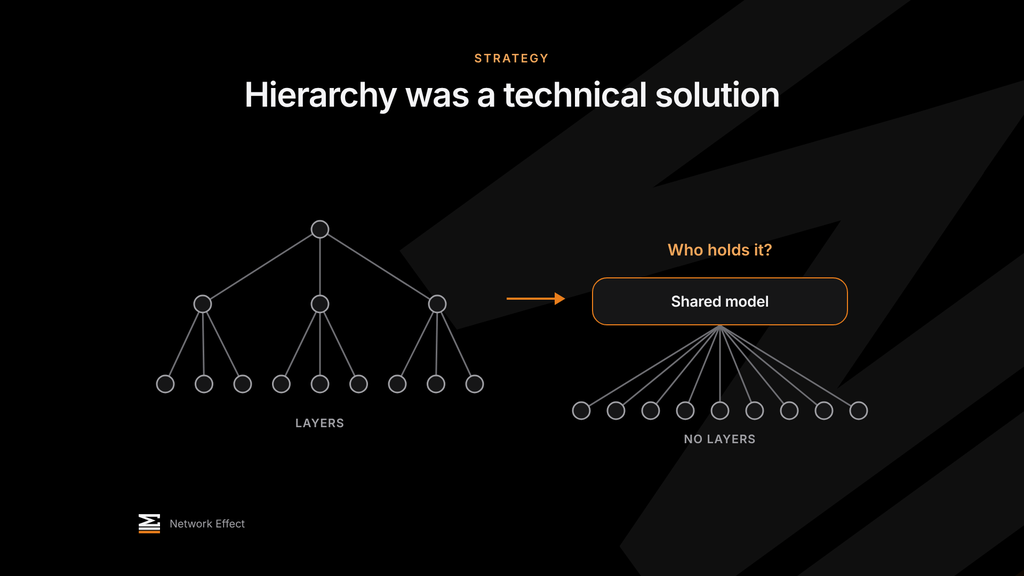
How fast a company moves is not a matter of culture. It is a matter of how information flows.
Why does my company have layers?
Because the pyramid is an engineering answer to a human constraint. That constraint has a name, span of control: the number of people one manager can follow directly. It is small, and it doesn't grow with talent.
The Roman army built the first great architecture on it: about eight men sharing a tent, a century of about eighty, a cohort of about four hundred and eighty, a legion of about five thousand. At each level, someone aggregated what came from below and relayed what came from above. It was an information routing protocol before it was a chain of command.
The centuries that followed refined the principle without changing it. After its defeat at Jena in 1806, the Prussian army reformed itself and gave rise to a general staff: for the first time, the people who executed were separated from the people who processed information. In 1855, Daniel McCallum, superintendent of the New York and Erie Railroad, drew what is regarded as the first company organisation chart, because trains spread over hundreds of miles could no longer be coordinated by word of mouth.
None of this was a moral choice or a management style. It was the only way. To coordinate a thousand people with five per manager, you need four or five layers. Arithmetic decided.
What does a middle layer actually do?
It moves information. Look at a middle manager's day: they receive a decision from above, translate it for their team, and consolidate the team's feedback to send back up. Receive, translate, consolidate. Each layer is a relay, and each relay works with a delay.
Each relay also adds noise. The message gets distorted on the way, like a whisper passed down a line. It gets filtered: whatever is awkward doesn't travel up. It picks up the interests of whoever passes it on. The more layers, the later the decision arrives, and the more it has changed by the time it does. That is why companies move fast or slow according to how their information flows, far more than according to the charisma of whoever runs them.
There has been no shortage of attempts to escape this: matrix organisations, autonomous teams, leaderless circles. All of them worked around the trade-off; none broke it. As they grew, nearly all of them drifted back to a pyramid, a flatter one perhaps, but a pyramid.
What is changing now?
A system can now maintain a continuous, accurate picture of the company, who is doing what, what has been decided, what is stuck, and use it to coordinate work. Until now, that coordination required humans in intermediate positions.
A public example has made this concrete. In March 2026, Jack Dorsey and Roelof Botha described, in a piece published by the venture firm Sequoia Capital, how Block, the payments company Dorsey runs, intended to do without a permanent middle management layer: a model of the company built from recorded work, and an organisation with three roles, the individual contributor, the person directly responsible for a problem, and the player-coach, who does as much as they lead. Nobody can yet say whether it works; the announcement is recent. But it draws the right distinction.
AI doesn't eliminate jobs. It eliminates layers. A layer is a position whose only function is synchronisation: moving information from one level to another. A role produces something else: judgement, decisions, direction. When information routing becomes software, it is the layer that loses its reason to exist, not the role of the person who held it. Most middle managers do both. The question is how much of their day goes to each.
What do we lose if we remove the layers?
A great deal, if we move too fast. Layers didn't only filter. They deliberated: a workshop supervisor who receives an absurd instruction argues with it before applying it. They translated the signal into local context: the same decision isn't explained the same way to accounting and on the shop floor. They absorbed uncertainty, taking on the small decisions nobody had anticipated. And they carried part of the responsibility.
Removing layers without saying who decides what produces one of two pathologies. Either decisions pile up at the top without anyone intending it: the top is connected straight to the base with no shock absorber, and the boss ends up with decisions they have no time to make. Or decisions get delegated without structure, and you get disorder from below. A faster signal is not a better signal; it can even be worse, if it removes the time to deliberate.
What works in a large tech company, where one person decides and answers for it, doesn't carry over as is to a mid-sized manufacturer, which needs to distribute decisions across its sites, its trades, its safety and compliance constraints. AI doesn't create the ability to decide; it demands it. And the layer you remove often comes back under another name, sign-off, control, compliance, because someone had to carry the risk.
So the wrong question is "should I remove my management layers?" The right one is "how will I write down who decides what?"
What stays human?
Three things, at least. Deciding while carrying the risk: an AI executes, it doesn't pay for its mistakes, and a decision made by someone who answers for it has a different weight. Judging before the market does: the taste that comes before validation, knowing an offer is right before the numbers say so. And helping people grow while building alongside them, which a player-coach does better than a relay.
The edge of the company, in contact with the customer, the site, the supplier, then becomes the place where action is possible, on one condition: that everyone there has the context. That is the real work. Rather than removing a layer, formalise it. Write down the decision rules it applied without ever stating them. Set how far a system may decide on its own, and from what point it escalates to a person. Keep a trace of every decision: why, by whom, on what basis. This is more demanding than removal, and along the way it reveals that many decisions had never been made explicit.
This is where intangible capital comes in. The shared model of the company, "built from recorded work", is that capital made readable: what the company knows, its decision rules, its weak signals, written down. Layers carried that context from head to head without writing it; if you remove them, it has to be written, or the system coordinates in a vacuum. You can't hand a system what you've never made explicit: before removing a layer, write down what it knew.
One question tells you whether the company is ready. What do you understand about your market that is genuinely hard to understand, and does that understanding deepen every day? If the answer is "nothing", removing layers will be a cost cut, not a transformation.
Who governs the system that replaces the layers?
This is the question the announcements leave out. The shared model of the company is a structure: lighter than a pyramid, but a structure. Those who build and update it decide what it sees, what it ignores, which questions can be asked of it. They hold more power than the old manager did, without the explicit accountability that came with the title.
Two risks follow. The first is an invisible technocracy: a few in-house experts define the frame within which everyone else thinks, without anyone having decided it. The second is a hierarchy relocated outside the company: if the model lives at a supplier, you have replaced your managers with a third party you don't audit, whose terms of service now serve as your rulebook. Before touching the layers, three questions. Who updates the model when the field contradicts it? How do we know it isn't wrong? And who holds it?
Bitcoin offers a tested answer here. In 1945, the economist Friedrich Hayek showed that the knowledge an economy needs is dispersed among millions of people, and that nobody holds all of it; prices coordinate without any centre needing to know everything, and central planning destroys that local information. Subsidiarity says the same thing in different words: decide at the level where information and responsibility actually sit. Bitcoin is the most radical demonstration of coordination without a centre. Thousands of machines that don't trust each other have kept a single ledger for more than fifteen years, because the rules are known to all, because every block is broadcast identically to everyone, the way the village bell rang the same hour for the employer and the worker with no keeper of the tower, and because each participant checks for themselves. Nobody runs it, and nobody can impose their version on the others.
The lesson for a business leader comes down to four properties. The system that replaces your layers must have explicit rules, known to everyone. It must give everyone the same information at the same time. It must be verifiable by anyone. And, as Bitcoin also learned, it must remain contestable. The variable is not "human or machine", nor even "in-house or outside": it is "contestable or uncontestable". A model you hold, that your teams can contradict from the field, and that you can walk away from, replaces a hierarchy. A model you rent, that nobody can contradict, creates a new one, harder to see.
The right question
The question was never whether you needed layers, but whether humans had to do what the layers did. For a business leader, the right question is not "how many managers can I remove?" but "who decides what, on what basis, and who holds the system that knows?"
That is the starting point of the strategic diagnosis: mapping your decisions, the ones layers filter, the ones they deliberate, the ones to write down and the ones to distribute, and, when it's time to decide, a FOCUS session. What you need to have written down before handing coordination to a system is described in Intangible capital. And why sovereignty, over money as over knowledge, ties Bitcoin and AI together: the Bitcoin × AI thesis.
Let's talk about your project.
A question, a training course, a payment or AI project? Write to us. We answer ourselves, and quickly.