Verification is the new bottleneck: who in your company can tell whether an AI's idea is true?
You ask an artificial intelligence (AI) for an analysis of your market. Ten seconds later you have a clean, well-argued, plausible text. You ask for a second one from another angle, then ten. They all hold together; none is wrong on a first read. And nobody in the company has the time, or always the expertise, to say which one is true for you. For centuries, the scarce thing was the idea. Today the idea is the cheapest resource in the room; the scarce thing is knowing which one is true, here, for you. That work has a name, verification, and it has become your company's bottleneck. Here is how to build it, and with whom.
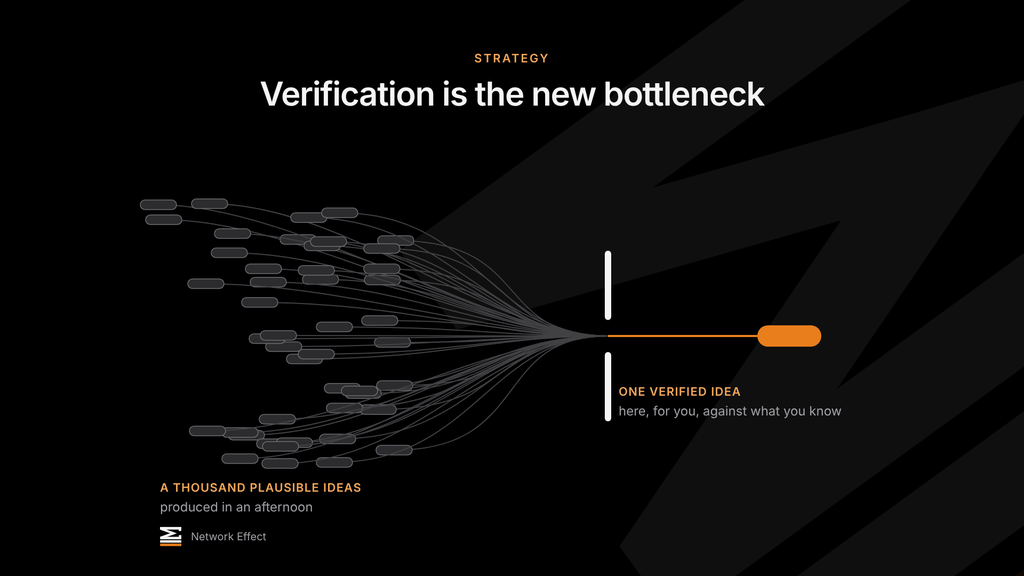
Ideas have become free. Truth has not.
Why hasn't AI made me surer of my decisions?
For centuries, scarcity sat on the production side: a hypothesis or a plan took months to mature, and a business owner with one good idea a quarter counted themselves lucky. An AI model now produces a thousand presentable hypotheses in an afternoon. The bottleneck has flipped.
But flipping it did not solve the problem of knowledge. It moved it, and made it bigger. Ten thousand explanations of something do not tell you which one is right. The mathematician Terence Tao said as much about science in March 2026, in a conversation with Dwarkesh Patel: AI has driven the cost of generating ideas down to almost zero; now they have to be verified and evaluated, and that is where everything jams. The filters science built for itself, peer review, journals, the slow forming of a consensus, were tuned for human speed. Under machine volume, they crack, the way the press cracked under the flood of the internet.
Your company lives the same thing at its own scale. Its meetings, its committees, its "we'll look into it" are filters tuned for ten ideas a month, not a thousand a week. We have automated creation; we have not automated truth. Hence a feeling many leaders recognise: never so much material to decide with, never so little confidence.
The temptation is to buy a verification machine. It will not work, because the verification that matters to a business owner is not that kind of thing.
Can a "true" idea be wrong for my company?
Yes, and that is a first principle, not a nuance. An idea produced by an AI can be right for the world at large and entirely wrong for your local market, your cost structure, the balance of power in your sector, the culture of your leadership team. An idea true in general can be false here. For a business owner, then, verifying does not mean checking that a text contains no mistakes. It means anchoring it: answering the question the model cannot ask for you. How does this idea play out in my context, not in a generic world?
That anchoring has a raw material, and on this site it has a name: intangible capital. What you know about your customers, your craft and your constraints, your weak signals, your exchanges with the real world. You do not check an idea against the world in general; you check it against what the company knows, and that knowledge only serves the purpose if it is written down somewhere you can read it again. An AI that cannot read this capital only produces generic ideas, and a team that never wrote it down can only verify as far as its memory goes. Our article on intangible capital covers what it holds, and how to keep it in-house.
The question upstream matters as much as the one downstream. Part of the scarcity has moved less towards verification than towards framing the right problems: an AI asked a bad question produces a thousand bad answers, at industrial scale, all well written. And a second question hides behind the first: who decides the criteria by which an idea "holds"? Verification is not a neutral technical problem. If your criteria are written nowhere, everyone checks against their own.
Anchoring takes someone who knows the ground, and this is where many companies reach for the wrong answer.
My teams review what the AI produces: isn't that enough?
The instinctive answer of most organisations is to hand generalists, helped by AI, the job of reviewing and approving what the machine produces, including outside their own field. It works for a while, on the obvious mistakes: an absurd figure, a reference that does not exist, an answer made up from scratch.
Then it stops working, for a reason of architecture rather than training: you cannot robustly check what you have not mastered. The generalist learns to spot the easy errors; that learning does not carry over to the subtle ones, and they do not know what they do not know. The AI does not help. It tends to agree with them, and lends them an expertise they do not have. Worse, if the whole organisation learns the same picture of the machine's mistakes, errors are no longer corrected by a diversity of eyes. They become systematic. The shortage of experts has not gone away; it is hiding behind a quieter shortage, of capable verifiers.
This does not rule out review by generalists. It holds when the organisation gives it three supports: written guardrails (documentation, standards), a systematic route to a specialist whenever the reviewer has doubts, and a real measure of the level expected of them. Without those, it reassures more than it protects.
So the useful question is not "can you train my people to use AI better?" It is "who in my company has the expertise and the time to robustly check what I am being offered?", and then: in which areas must I keep expertise in-house, and where is a well-equipped generalist truly enough? That sorting is not technical. It is strategic, and it belongs to the business owner.
Before asking who verifies, one illusion about what "verifying" means with AI has to go.
Do I need to understand how AI works before I trust it?
No, and demanding it is paralysing. For forty years, business computing was built on determinism: every action auditable, every decision justifiable line by line, the code as the source of truth. An AI model does not exist as readable lines but as billions of parameters set by training. Demanding a mechanical proof of its behaviour applies the rules of a world it has left.
Yet human trust has always been statistical. You do not get into a taxi after auditing the driver's brain; you get in because collective experience is favourable, and because you know whom to call if the ride goes wrong. The right question is not "do I understand how it works?" but "have I built what lets me see what it produces?" That means instruments showing what the AI produces (its outputs, results, anomalies, side effects), designed before deployment rather than after the first incident, and a written answer to a simple question: who carries what when the statistics fail, and how will I find out? Deploying without those instruments means depending on whoever will be the only one to know what is failing.
The taxi image has limits, and they should be said. It assumes long statistics and known failure modes. For AI applied to a specialised trade, neither is a given. A mistake in a product suggestion does not weigh what a mistake in a quote, a contract or a diagnosis weighs: the level of observation has to follow how serious the delegated decision is.
Watching what the machine produces is half the work. The other half is having someone contradict you.
Who around me has nothing to gain from agreeing with me?
Nobody can challenge their own thinking from the inside. And AI has a slope: it agrees with you. The verification that matters is therefore not a personal reflex. It is a set-up.
AI has also changed the economics of contradiction. In 2013 the Italian programmer Alberto Brandolini stated a principle of asymmetry: refuting nonsense takes far more energy than producing it. AI has collapsed the cost of refutation: an appealing but wrong argument no longer survives long against the first well-equipped reader. Titles, degrees and eloquence no longer protect a line of reasoning; only its connection to reality does. That holds for the ideas people sell you, and for your own. A fake refutation, admittedly, is produced as fast as a real one: all the more reason to choose who contradicts you.
A set-up for contradiction has three parts. Outside views, different from one another, with no interest in validating your blind spots. A method, made of plain and blunt questions: which implicit assumption has not been shown? What would it take for this to hold? What opposite conclusion do the same facts allow? And a written trace of the reasoning, so that a decision can be reread, and so contradicted, and so revised: what is written shows its flaws; what is said evaporates.
Finally, accept one thing: absolute verification never existed. You act with an explicit degree of confidence, on a stated basis, revisable in a planned way. The question is not "is it true?" but "with what degree of confidence, on what basis, revisable how?"
One system put exactly this set-up at its core more than fifteen years ago, and it has an economic lesson to offer.
What does verification cost, and what does it pay?
Bitcoin is the first large-scale system built on a motto: "don't trust, verify". Every node, a computer that checks the chain, re-runs the check of every rule itself instead of believing a result announced by someone else. The rules are public, written, and the same for everyone; as early as 2008, Satoshi Nakamoto wanted a system "based on cryptographic proof instead of trust". And proof of work has the property this article has been looking for from the start: it is costly to produce and trivial to verify. A block proves that real energy was spent, and anyone can check it in a fraction of a second. Digitised capital, the other face of intangible capital, is thus the only kind anyone can verify for themselves, roughly every ten minutes.
The lesson for a company is a structure: verification is not the opposite of speed; it is what lets you do without blind trust, on two conditions, that the rule is written down and that whoever checks re-runs the calculation themselves. Translated: your decision criteria in writing, people who redo the reasoning instead of reading the conclusion, and the acceptance that a well-presented idea proves nothing any more, since it costs nothing to produce.
That is where the advantage lies. The company that builds this set-up turns an abundance of ideas into decisions; the one that does not is swamped by it: a hundred plausible ideas, none tested, none applied. The competitive edge is no longer in the capacity to produce ideas; it is in the system that filters them. Checking what AI produces is one thing; deciding what you ask it to optimise is another, and the subject of another article.
AI will not give you better decisions. It will give you more ideas, and the burden of saying which ones are true. What becomes scarce is not intelligence: it is a verification set-up anchored in your reality.
That is the point of a FOCUS session: a day in which your strategy is put to the test by several people with no interest in validating your blind spots, starting from your real context, with a written debrief you can reread and revise. And if that context is still written down nowhere, CORPUS starts there: recording what you verify against.
Let's talk about your project.
A question, a training course, a payment or AI project? Write to us. We answer ourselves, and quickly.